Bangladesh Officially Refuses to Play 2026 T20 World Cup in India – Full Details & Impact
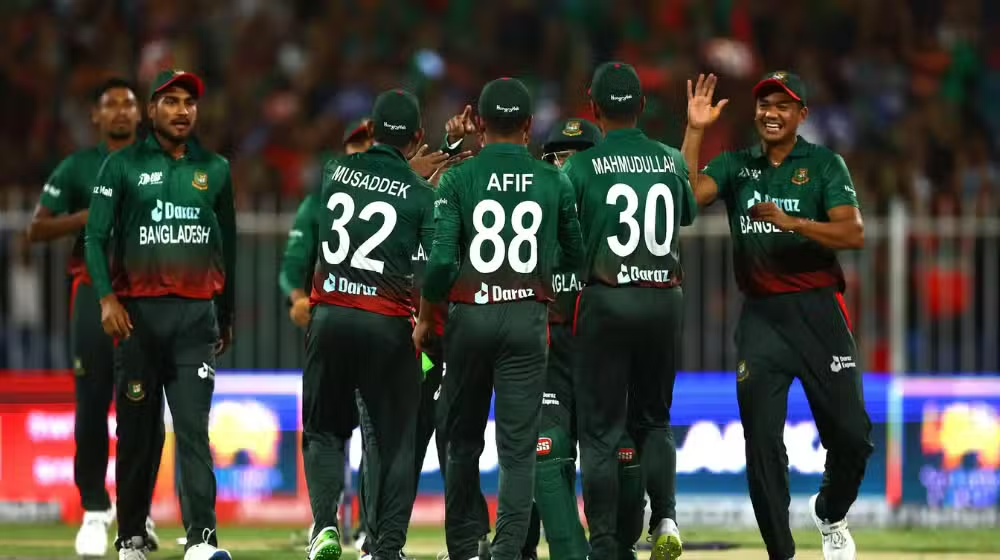
Bangladesh has officially refused to travel to India for the 2026 Men’s T20 World Cup, creating a major development in international cricket just weeks before the tournament. The decision was announced by the Bangladesh Cricket Board (BCB) and is based on serious security concerns and worsening political relations between Bangladesh and India.
With the event jointly hosted by India and Sri Lanka, Bangladesh’s withdrawal from matches scheduled in India has placed the International Cricket Council (ICC) in a difficult position, forcing it to reconsider fixtures, venues, and tournament logistics.
This article explains why Bangladesh refused to play the T20 World Cup in India, the role of Mustafizur Rahman and the BCCI, ICC’s possible options, and the wider impact on world cricket.
Bangladesh Refuses to Play 2026 T20 World Cup in India
In a significant announcement, the Bangladesh Cricket Board confirmed that the national team will not travel to India for the 2026 T20 World Cup under the current circumstances.
The decision comes only one month before the tournament, making it one of the most serious disruptions in recent ICC event history.
According to the BCB, the move was taken after:
- A full security assessment
- Advice from the Bangladesh government
- Internal board meetings involving senior officials
Why Did Bangladesh Refuse to Travel to India?
The BCB cited multiple reasons behind its refusal, with security concerns at the top of the list.
1. Security Concerns for Players
A senior BCB official revealed that the Board of Control for Cricket in India (BCCI) had expressed its inability to guarantee security for Mustafizur Rahman, Bangladesh’s star pacer.
The official stated:
“If India cannot provide security for one player, how can they ensure safety for the entire team?”
This statement became a turning point in the decision-making process.
2. Mustafizur Rahman and KKR Controversy
The situation worsened after reports emerged that the BCCI instructed Kolkata Knight Riders (KKR) to release Mustafizur Rahman.
This raised serious concerns within the BCB, especially since:
- The BCCI had earlier asked Bangladesh to ensure Mustafizur’s availability for the IPL auction
- No clear security explanation was provided
The BCB later wrote a formal letter to the BCCI seeking clarification on Mustafizur’s removal from the KKR squad.
3. Deteriorating Political Relations
Bangladesh officials pointed to deteriorating political and diplomatic relations between the two countries.
Bangladesh’s sports adviser Asif Nazrul publicly supported the decision, stating that it was taken:
“In the context of the radical communal policies of the Indian cricket board.”
This political dimension has added further sensitivity to the issue.
Bangladesh’s Scheduled Matches in India
Before the withdrawal, Bangladesh was scheduled to play multiple matches in India, including:
- Opening match vs West Indies
- Venue: Eden Gardens, Kolkata
- Additional matches planned in Mumbai
With Bangladesh pulling out, these fixtures are now in doubt.
Bangladesh Requests ICC to Relocate Matches
The BCB has formally requested the International Cricket Council (ICC) to move all of Bangladesh’s matches outside India.
Preferred Alternative Venue
According to officials, Bangladesh is willing to play its matches in:
- Sri Lanka
A senior BCB official said:
“We can’t play in India. We can play in Sri Lanka.”
ICC’s Dilemma: No Hybrid Model for T20 World Cup 2026
One of the biggest challenges is that the 2026 T20 World Cup does not follow a hybrid model, unlike the 2025 Champions Trophy.
Key Complications for ICC:
- Tournament jointly hosted by India and Sri Lanka
- Fixtures already finalized
- Ticket sales, broadcasting, and logistics affected
- No clear precedent for relocating one team’s matches only
As of now, it remains unclear whether the ICC will accept Bangladesh’s request.
BCB’s Emergency Meetings Before Final Decision
According to ESPNcricinfo, the BCB held two lengthy virtual meetings in the last 24 hours before making the decision.
Meeting Timeline:
- Saturday: No conclusion reached
- Sunday (1 pm): 17 directors attended
- Outcome: Unanimous decision to inform ICC
The board emphasized that the decision was taken collectively and with government input.
Safety of Fans and Journalists Also a Concern
Beyond players, the BCB also considered the safety of:
- Bangladeshi fans
- Journalists
- Support staff
With thousands expected to travel for the World Cup, the board felt it could not risk lives under uncertain conditions.
Bangladesh Also Confirms Asia Cup Squad
Despite the T20 World Cup controversy, Bangladesh has confirmed its Asia Cup squad, showing that the team remains fully committed to international cricket—just not under unsafe conditions.
This highlights that the refusal is location-specific, not tournament-related.
How This Decision Impacts the 2026 T20 World Cup
Bangladesh’s refusal could have wide-ranging consequences:
1. Fixture Disruption
Key matches may need rescheduling or relocation.
2. Broadcast and Revenue Impact
Bangladesh has a massive fan base, and their absence from Indian venues could affect:
- TV ratings
- Sponsorship deals
3. Political Precedent
This decision could encourage other teams to raise security or political concerns in future tournaments.
Could Bangladesh Withdraw Completely?
As of now:
- Bangladesh has not withdrawn from the tournament
- They are only refusing to play in India
- Willing to play at neutral or Sri Lankan venues
A full withdrawal would be a last resort.
Possible Scenarios ICC May Consider
The ICC now has several options:
- Relocate Bangladesh matches to Sri Lanka
- Negotiate additional security guarantees with India
- Reschedule fixtures entirely
- Risk Bangladesh’s absence from Indian matches
Each option carries logistical and political risks.
Historical Context: Politics and Cricket in South Asia
Cricket in South Asia has often been affected by politics. Past examples include:
- Pakistan’s matches moved to neutral venues
- India-Pakistan bilateral series suspensions
- Hybrid tournament models
Bangladesh’s decision fits into this broader regional pattern.
Conclusion
The decision by Bangladesh to refuse playing the 2026 T20 World Cup in India marks a serious moment in international cricket. Driven by security fears, political tensions, and player safety concerns, the move has placed the ICC under pressure to find a workable solution.
As the tournament approaches, all eyes are now on the ICC’s response and whether diplomacy and cricket administration can resolve the situation without damaging the spirit of the game.
FAQs – Bangladesh T20 World Cup 2026 India Issue
Q1: Has Bangladesh withdrawn from the 2026 T20 World Cup?
No, Bangladesh has only refused to play matches in India.
Q2: Why did Bangladesh refuse to travel to India?
Due to security concerns, political tensions, and lack of safety guarantees for players.
Q3: What role did Mustafizur Rahman play in this decision?
The BCCI reportedly could not guarantee his security, raising alarms for the entire team.
Q4: Where does Bangladesh want to play its matches?
Bangladesh has requested the ICC to move matches to Sri Lanka.
Q5: Will ICC accept Bangladesh’s request?
It is still unclear. The ICC is reviewing the situation.