ACAG Punjab Land Ownership Rules 2025 – Eligibility Criteria for Applicants

The Punjab government’s flagship Apni Chhat Apna Ghar program has given hope to thousands of families who dream of owning a safe and permanent home. But before submitting an application, every family must understand the ACAG Punjab Land Ownership Rules 2025.
These rules set the foundation for who qualifies, ensuring that only deserving households without existing property can benefit. By reviewing the ACAG Punjab Land Rules 2025 and following the official ACAG Land Ownership Requirements, families can avoid rejection and apply with confidence.
The government has simplified this process by introducing online eligibility checks through acag.punjab.gov.pk criteria, allowing applicants to perform a quick Apni Chhat Apna Ghar Eligibility Check and confirm if they meet the Apna Ghar Scheme Eligibility standards.
Why Land Ownership Rules Matter in Housing Programs
No government housing scheme can succeed without a fair set of rules. The ACAG Punjab Land Ownership Rules 2025 ensure:
- Fair distribution – Only families without houses or large plots are included.
- Transparency – Applicants can verify their eligibility online.
- Prevention of misuse – Wealthy households cannot occupy places meant for low-income families.
- Trust building – Citizens believe in the fairness of the system.
By enforcing strict acag punjab land rules 2025, the government makes sure the program benefits the right people.
Key Highlights of ACAG Punjab Land Rules 2025
The acag punjab land rules 2025 clearly define who qualifies and who does not. Major highlights include:
- No Ownership of a House – Families that already own a permanent residential house cannot apply.
- Agricultural Land Restrictions – Applicants with agricultural land beyond the specified limit are disqualified.
- Residential Plot Limits – Households holding large urban plots are not eligible.
- Joint Family Ownership – If one member owns property, the entire family’s eligibility is affected.
- Commercial Property Restrictions – Shops, plazas, or business plots reduce eligibility chances.
- Digital Verification – Every claim is checked through acag.punjab.gov.pk criteria and NADRA systems.
Apna Ghar Scheme Eligibility – Who Can Apply?
The Apna Ghar scheme eligibility is designed to help low and lower-middle-income households. Eligible applicants include:
- Families without any owned house or plot.
- Renters facing financial pressure due to high rents.
- Widows, orphans, and disabled citizens needing secure housing.
- Daily wage laborers struggling to arrange permanent shelter.
- Families living in temporary or unsafe housing conditions.
These categories align with the acag land ownership requirements and prioritize those in urgent need.
Read More: How to Track ACAG Application Status
Detailed Explanation of ACAG Land Ownership Requirements
The acag land ownership requirements are strict but fair. Here’s what they mean:
- Urban Residents – Must not own residential plots larger than the allowed size.
- Rural Residents – Cannot possess agricultural land beyond the small household quota.
- Shared Property – Even if property is registered under a family member, the entire household may be disqualified.
- Commercial Holdings – Families with income from large commercial property will not qualify.
These checks ensure fairness and reflect the official acag.punjab.gov.pk criteria.
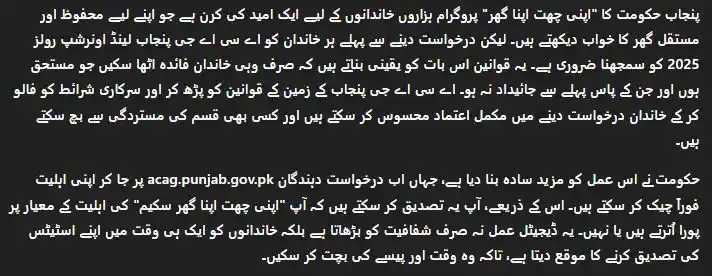
How to Perform Apni Chhat Apna Ghar Eligibility Check
Applicants can confirm their status through the official portal. Steps for Apni Chhat Apna Ghar eligibility check:
- Visit the Website – Open acag.punjab.gov.pk criteria.
- Enter CNIC – Provide the valid CNIC for digital verification.
- Submit Details – Enter basic family and income details.
- System Cross-Check – Portal verifies with land records and NADRA.
- Result Shown – Eligibility result displayed instantly.
This digital method simplifies the apna ghar scheme eligibility process.
Benefits of Clear Land Ownership Rules
The introduction of ACAG Punjab Land Ownership Rules 2025 has multiple benefits:
- Fair Selection – Priority given to landless and low-income families.
- Reduced Corruption – Online process reduces reliance on agents.
- Quick Access – Eligibility results available instantly.
- Equality – Both urban and rural households are treated equally.
- Peace of Mind – Families know upfront if they qualify.
By enforcing acag land ownership requirements, the government has created a fair and transparent system.
Common Mistakes Leading to Disqualification
Applicants often lose eligibility due to errors such as:
- Entering a wrong or incomplete CNIC.
- Hiding family-owned land or property.
- Submitting duplicate applications from one household.
- Ignoring the Apna Ghar scheme eligibility rules.
- Providing false documents or income details.
Avoiding these mistakes is essential for passing the apni chhat apna ghar eligibility check.
Safety Measures While Applying
Families must remain cautious when applying:
- Use only the official acag.punjab.gov.pk criteria portal.
- Never pay agents promising quick approval.
- Enter only accurate CNIC and family details.
- Confirm your property status before filling the form.
- Keep checking eligibility status online for updates.
These steps protect applicants and ensure smooth compliance with the acag punjab land rules 2025.
How Land Ownership Rules Build Trust
The ACAG Punjab Land Ownership Rules 2025 are not just legal conditions—they are the backbone of fairness in the Apni Chhat Apna Ghar scheme. By excluding wealthy families and ensuring low-income households are prioritized, these rules:
- Create equal opportunities.
- Build trust among citizens.
- Strengthen the credibility of government initiatives.
- Provide hope to genuine families who need housing the most.
By sticking to the acag land ownership requirements, the scheme achieves its true purpose.
Read more: ACAG PMT Score 2025
Frequently Asked Questions (FAQs)
Q1: What are the ACAG Punjab Land Ownership Rules 2025?
Ans: They are the official rules that define who qualifies for the housing program based on land and property ownership.
Q2: How can I check eligibility?
Ans: Visit acag.punjab.gov.pk criteria and use your CNIC for online verification.
Q3: Who is disqualified under Apna Ghar scheme eligibility?
Ans: Families already owning houses, large agricultural plots, or commercial property.
Q4: What documents are needed for Apni Chhat Apna Ghar eligibility check?
Ans: CNIC, family details, and proof of residence in Punjab.
Q5: What is included in ACAG land ownership requirements?
Ans: Conditions about residential plots, agricultural land, and family property checks
Conclusion
The ACAG Punjab Land Ownership Rules 2025 provide a transparent and fair system to decide who qualifies for Punjab’s Apni Chhat Apna Ghar housing program. By following the ACAG Punjab Land Rules 2025, applicants can check whether they fall within the official framework of Apna Ghar Scheme eligibility. The strict but fair ACAG land ownership requirements ensure that only genuine low-income families are selected, while the Apni Chhat Apna Ghar Eligibility Check helps applicants confirm their status quickly.
With digital access through acag.punjab.gov.pk criteria, families no longer need agents or offices to confirm eligibility. These rules not only build trust but also guarantee that housing support reaches the families who need it most. For thousands across Punjab, meeting these criteria is the first step towards stability, dignity, and home ownership.