Punjab Govt Launches Free Cattle Vaccination for Livestock Card Holders 2025 – Full Details
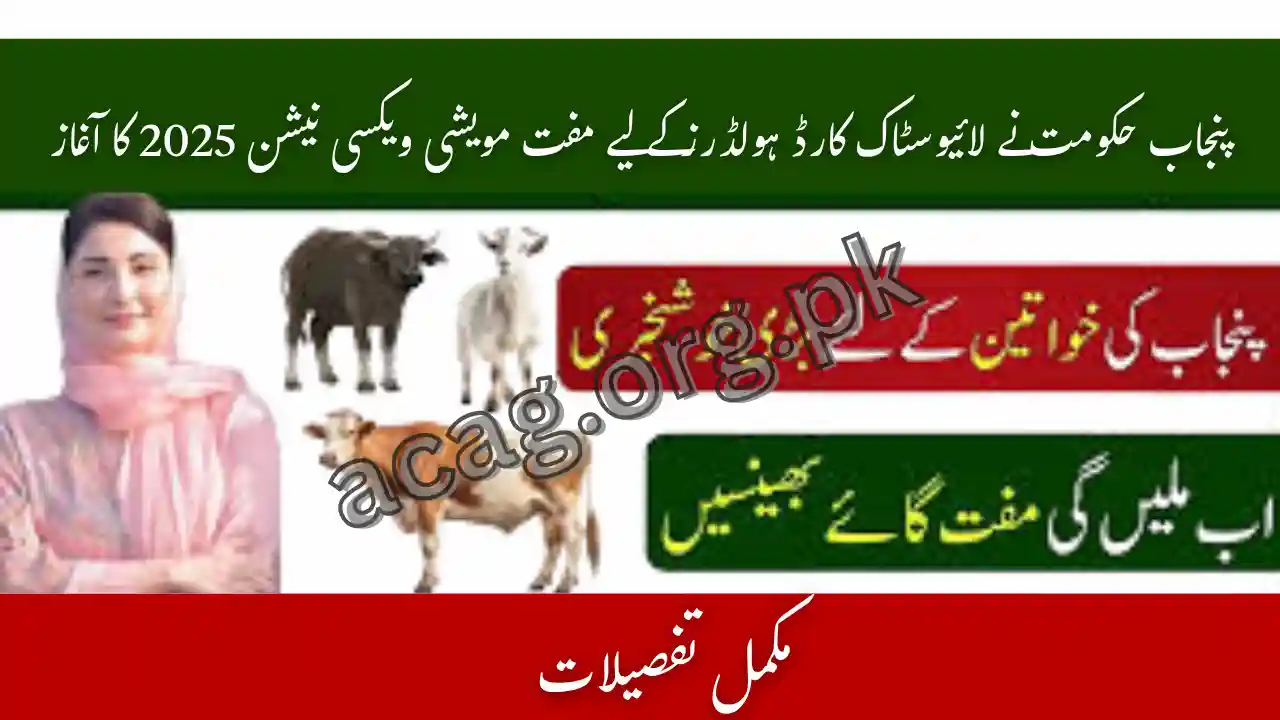
The Punjab Govt Launches Free Cattle Vaccination for Livestock Card Holders 2025 has officially launched a large-scale free cattle vaccination and digital tagging program for all farmers registered under the Punjab Livestock Card initiative in 2025. This groundbreaking campaign aims to improve animal health, increase disease-resistance, promote traceability, and enhance productivity in dairy and meat sectors across the province. With livestock contributing significantly to household income in rural communities, the government’s decision to introduce free vaccinations marks a revolutionary step toward protecting Pakistan’s agricultural economy.
Under this initiative, official veterinary teams have started visiting cattle farms, village livestock centers, dairy suppliers, and backyard livestock owners to administer timely vaccinations. These vaccines are being provided completely free of cost for eligible farmers, ensuring that financial challenges do not prevent animal owners from accessing quality veterinary care.
This detailed article explains the complete roadmap of the 2025 cattle vaccination drive, including objectives, registration status, eligibility, benefits, process, digital tagging, impact on subsidies, field operations, farmer responsibilities, and more.
✅ Livestock Health – A Critical Component of Pakistan’s Economy
Livestock is one of Pakistan’s most valuable economic pillars. Nearly 67% of rural households depend on cattle for:
- Milk production
- Meat supply
- Income generation
- Farming labor support
- Leather and dairy industries
- Household nutrition
When animals are affected by viral infections such as Foot-and-Mouth Disease (FMD), Hemorrhagic Septicemia (HS), or Lumpy Skin Disease (LSD), productivity drops drastically, leading to:
- Milk shortages
- Reduced fertility rates
- Increased mortality
- High veterinary costs
- Loss of household income
To control these threats, the Punjab government has decided to immunize livestock through professional vaccination campaigns.
✅ Why the Government Started Free Cattle Vaccination in 2025
Several crucial reasons led to this initiative:
- Rise in viral livestock outbreaks across South Asia
- Rapid spread of untreatable diseases
- Farmer complaints about expensive veterinary care
- Need for traceable health record systems
- Importance of improving dairy yield
- Protection of national food security
- Boosting rural economic stability
By providing vaccines free of cost, the government aims to create disease-resistant herds and a digitally monitored livestock database.
Read More: Complete Guide to AZAG Program 2025
✅ Digital Tagging Under Livestock Card – How It Works
Every vaccinated animal receives a yellow ear tag, which represents:
- Unique identification number
- Owner details
- Breed & age
- Vaccination history
- Eligibility for subsidies
- Health status
This helps the government track:
- Vaccination cycles
- Breed population
- Disease outbreaks
- Animal movement
The tagged animal becomes part of the Punjab Livestock Card database.
✅ Areas Covered Under This Campaign
The vaccination campaign is being executed province-wide, including:
- Villages
- Remote livestock communities
- Dairy farms
- Cattle sheds
- Private barns
- Rural marketplaces
Field staff are traveling district-to-district to ensure no eligible animal is missed.
✅ Eligibility Criteria for Free Cattle Vaccination 2025
To receive free vaccinations, livestock must meet the following conditions:
- The animal must be registered under the Punjab Livestock Card.
- Owner must have verified identity through CNIC.
- Details of livestock must match the digital database.
- Animals must be available when the team arrives.
- Farmer should cooperate with veterinary staff.
Unregistered animals may be documented on-spot, depending on availability.
✅ Types of Vaccines Being Provided
Government veterinary teams are administering vaccines against:
- Foot-and-Mouth Disease (FMD)
- Lumpy Skin Disease (LSD)
- Hemorrhagic Septicemia (HS)
- Black Quarter (BQ)
- Enterotoxemia
- Brucellosis (where required)
- Deworming shots (district-based)
Vaccination needs may vary district to district depending on viral intensity.
✅ Step-by-Step Process for Free Cattle Vaccination
Here is how a typical vaccination visit works:
Step 1: Veterinary awareness teams arrive in the village.
Step 2: They verify livestock card registration.
Step 3: The farmer presents cattle for physical examination.
Step 4: Vaccinations are administered by trained professionals.
Step 5: Each animal receives a yellow ear tag.
Step 6: Digital data entry is done on government software.
Step 7: Farmer is guided about follow-up care and vaccination schedule.
This ensures complete digital traceability.
✅ Documents Required
Farmers may be asked to present:
- CNIC (Original)
- Livestock Card (if issued)
- Proof of animal ownership
- Registered contact number
These documents help confirm eligibility.
✅ Health Benefits for Vaccinated Animals
The program offers multiple advantages:
- Prevents fatal diseases
- Boosts immunity system
- Reduces treatment costs
- Improves milk production
- Enhances fertility
- Reduces mortality rate
- Improves market value of animals
Healthy cattle = Higher farm profit.
✅ Economic Impact on Farmers
This free campaign helps farmers save money on:
- Costly vaccinations
- Medical treatment bills
- Repeated outbreaks
- Loss of milk yield
On average, farmers save Rs. 8,000–15,000 per animal annually.
✅ Why Ear Tagging is Important
Tagging allows:
- Subsidized feed supply
- Easy loan processing
- Disease tracking
- Proof of ownership
- Participation in government schemes
Without a tag, access to future benefits may be affected.
✅ Government’s Long-Term Strategy
The Punjab government plans to:
- Expand vaccination coverage
- Digitize complete livestock records
- Introduce insurance schemes
- Provide low-interest loans
- Offer feed subsidies
- Launch AI-based health monitoring
This creates a sustainable livestock ecosystem.
✅ Farmer Responsibilities
Farmers must:
- Present animals when the team arrives
- Maintain cleanliness
- Follow post-vaccination guidelines
- Monitor animal health regularly
- Inform authorities about outbreaks
Cooperation accelerates efficiency.
✅ Consequences of Not Vaccinating Cattle
Unvaccinated animals may suffer from:
- Lower milk output
- Weak immunity
- Viral infections
- Painful skin diseases
- Sudden death in outbreaks
They may also become ineligible for:
- Subsidies
- Breed improvement programs
- Veterinary insurance
Read More: ACAG Social Impact: Apni Chhat Apna Ghar Program 2025
✅ Impact on Dairy Industry
The dairy sector benefits through:
- Higher milk production
- Better quality control
- Fewer disease outbreaks
- Improved export potential
Punjab contributes nearly 65% of Pakistan’s total milk supply.
✅ Farmer Feedback and Public Response
Initial feedback shows:
- Farmers are appreciative
- Reduced vaccination costs
- Improved awareness
- Increased trust in government teams
Social media campaigns are spreading awareness effectively.
✅ Future Expansion Possibilities
The program may expand to:
- Goat vaccinations
- Poultry immunization
- Buffalo breed improvement
- Farm management training
Technology will play a huge role going forward.
🟢 Conclusion:
The Punjab Govt Launches Free Cattle Vaccination for Livestock Card Holders 2025 is a historic milestone in Pakistan’s livestock development vision. This large-scale initiative not only protects animal health but also improves farmer income, enhances food security, and modernizes rural dairy systems using digital frameworks.
By offering free vaccinations, digital tagging, and health monitoring, the government ensures a disease-free livestock ecosystem. Farmers are strongly encouraged to cooperate with veterinary teams to protect their herds, reduce medical expenses, and qualify for future livestock subsidies.
This project is expected to uplift thousands of rural families, boost milk production, and contribute directly to Pakistan’s national economy.
❓ FAQs – Punjab Livestock Card Free Cattle Vaccination 2025:
1. What is the Punjab Livestock Card Cattle Vaccination Program 2025?
It is a government initiative providing free vaccination and digital ear tagging to eligible livestock across Punjab to prevent viral diseases and increase cattle productivity.
2. Is the free cattle vaccination available across all districts of Punjab?
Yes, the campaign covers all districts, and field teams are actively visiting rural villages, farms, sheds, and cattle centers.
3. How can farmers register their cattle to receive free vaccination?
Farmers must get their animals enrolled in the Punjab Livestock Card database through local livestock offices or on-spot verification by field teams.
4. What documents are required to avail free cattle vaccination in 2025?
CNIC, Livestock Card (if issued), ownership proof, and registered phone number may be required during verification.
5. Does digital ear tagging help in subsidy eligibility?
Yes, tagged animals with digital records become eligible for future subsidies, health benefits, feed support, and possible insurance programs.
6. What diseases are covered under this free vaccination drive?
Major diseases include Lumpy Skin Disease (LSD), Foot-and-Mouth Disease (FMD), Black Quarter (BQ), Hemorrhagic Septicemia (HS), and Enterotoxemia.
7. Where can farmers contact for vaccination schedule or complaints?
Farmers can call the 24/7 toll-free helpline 08000-9211 for assistance, complaint registration, or vaccination schedule updates.
8. Can unregistered cattle be vaccinated under this program?
Only registered livestock are eligible, but some field teams may assist in on-spot registration if data availability permits.
9. What should farmers do if an animal loses its ear tag?
Immediately report to the nearest livestock office or helpline to request a replacement tag to avoid eligibility issues.
10. Does vaccination improve milk production and fertility?
Yes, vaccinated and disease-free cattle show better milk yield, breeding performance, and overall herd health.
11. Are there any hidden charges for vaccination or tagging?
No, the entire vaccination and tagging process is completely free for eligible Livestock Card holders.
12. Will unvaccinated cattle face movement restrictions in the future?
Possibly, government may require vaccination status for inter-district transport to prevent disease spread.
13. How can farmers verify if the vaccination data is updated digitally?
Field staff upload data to the Punjab Livestock Card system; farmers can request confirmation from district offices.
14. Can farmers register multiple cattle under one Livestock Card?
Yes, multiple animals belonging to the same household/farm can be linked to one owner’s CNIC-based Livestock Card.
15. Are small livestock owners eligible for this drive?
Yes, this program focuses on supporting small and economically weak farmers across rural Punjab.