Pakistan Installs New E-Boarding Kiosks at Airports – Faster Check-In Begins
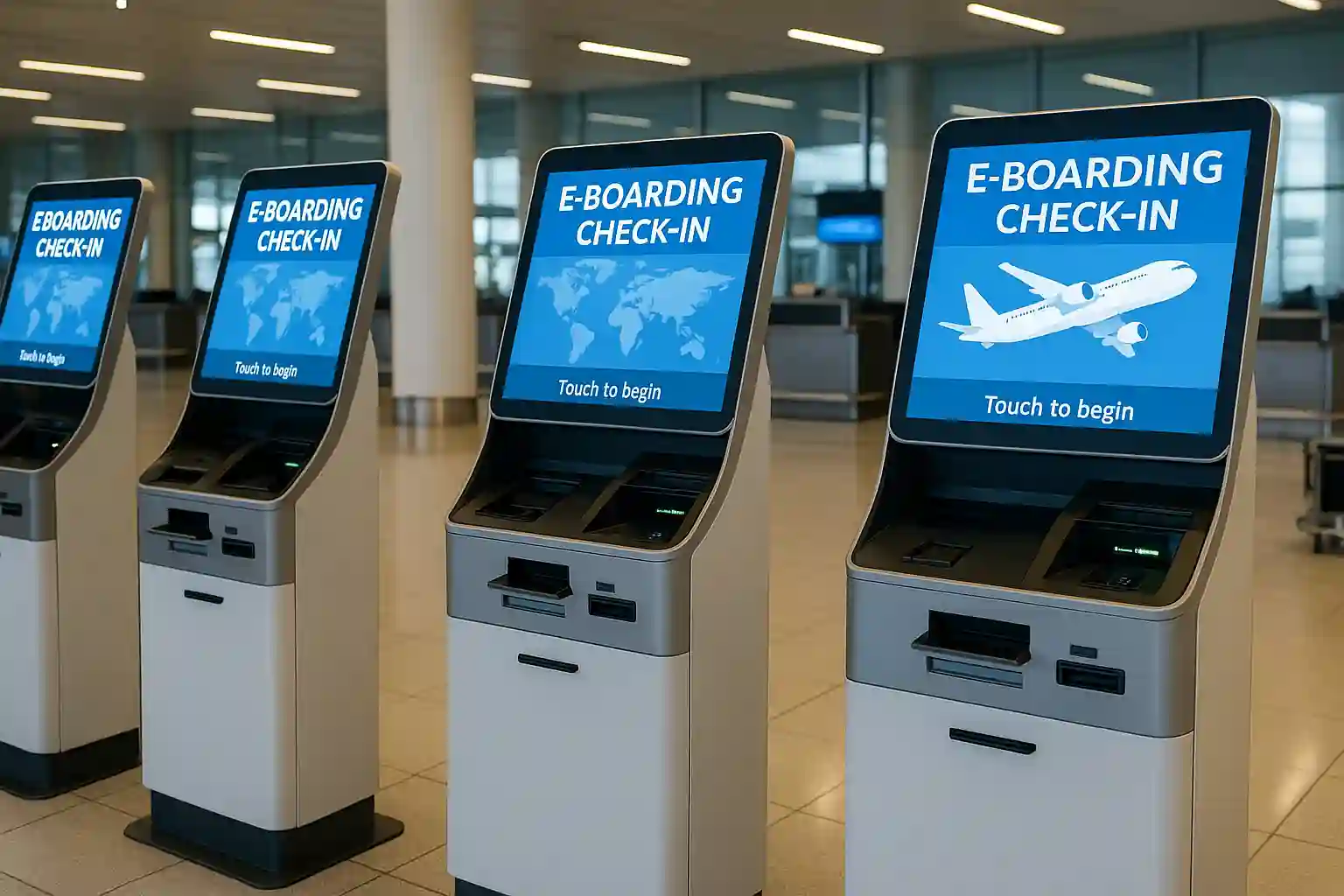
Pakistan’s aviation sector has entered a new era of digital transformation as new e-boarding kiosks have been installed at major airports, finally allowing passengers to experience faster check-ins, shorter queues, self-service boarding passes, and contactless travel processing.
The Pakistan Civil Aviation Authority (PCAA) confirmed that these kiosks are now operational at multiple terminals, with more installations planned across the country. The initiative aims to bring Pakistan’s airports on par with global aviation standards and significantly improve passenger convenience—especially during peak travel hours.
2. What Are E-Boarding Kiosks? – Digital Travel Explained
E-boarding kiosks are automated self-service machines that allow passengers to:
- Check in without going to airline counters
- Print boarding passes instantly
- Scan passports or CNIC for verification
- Select seats where available
- Drop luggage faster (in supported airports)
- Avoid long queues at counters
These kiosks rely on a highly secure biometric and digital record-matching system, which cross-verifies passenger identity with airline and NADRA databases.
Read Also: MG Binguo EV Expected Price in Pakistan – Full Specs, Launch Date & Features
3. Why Pakistan Introduced E-Boarding Kiosks – Key Reasons
Pakistan’s airports, especially Islamabad, Karachi, and Lahore, face massive footfall. Traditional check-in counters often become congested during:
- Umrah & Hajj seasons
- School holiday periods
- Peak travel hours
- International event windows
The PCAA introduced the system to solve long-standing problems:
3.1 Reduce Long Queues
Passengers previously waited 45–90 minutes for manual check-in during rush hours.
3.2 Improve Security with Digital Identity Matching
The kiosks eliminate human error and match traveler data automatically.
3.3 Speed Up Boarding Process
Self-service reduces time spent per traveler by up to 60%.
3.4 Enhance Passenger Experience
Air travel becomes smoother, more predictable, and stress-free.
3.5 Align with Global Aviation Standards
Most modern airports worldwide use self-boarding systems; Pakistan is now aligning with this trend.
4. Where Are E-Boarding Kiosks Installed? – Airport Locations
The PCAA has rolled out the first phase at:
4.1 Islamabad International Airport
- New kiosks installed in multiple departure lounges
- Supports domestic and international check-ins
4.2 Lahore Allama Iqbal International Airport
- High traffic makes self-service essential
- Reduces pressure on airline counters
4.3 Karachi Jinnah International Airport
- Kiosks installed near major airline counters
- Helps manage large domestic passenger flow
4.4 Future Expansion
Kiosks will soon be installed at:
- Peshawar International
- Multan International
- Faisalabad International
- Quetta International
This will bring uniformity to Pakistan’s aviation system.
5. How E-Boarding Kiosks Work – Step-by-Step Process
The new system is designed for simplicity. Here’s the full process:
Step 1: Approach the E-Boarding Kiosk
Touch the screen to start.
Step 2: Scan Passport or CNIC
The system automatically fetches your booking details.
Step 3: Choose Your Airline & Flight
The kiosk displays all scheduled flights.
Step 4: Verify Your Details
Confirm your:
- Name
- Flight number
- Departure gate
- Seat number
Step 5: Select or Change Seat (If Allowed)
Step 6: Print Boarding Pass
A high-quality pass is printed in seconds.
Step 7: Proceed to Security Clearance
For luggage:
Some airports support self-service baggage drop, coming soon nationwide.
Read More: Punjab Wheat Production Competition 2026 – Apply Online for Tractors & Million-Rupee Cash Prizes
6. Benefits of New E-Boarding Kiosks for Passengers
6.1 Faster Check-In (60% Time Saved)
Passengers avoid queues and complete check-in in less than 1–2 minutes.
6.2 Reduced Human Interaction
Ideal for contactless travel, especially after COVID-19.
6.3 Accurate Data Matching
The system eliminates spelling mistakes and manual input errors.
6.4 24/7 Availability
Passengers do not depend on staff or counter timings.
6.5 Supports Digital Travel Ecosystem
Fully aligns with global smart airport standards.
7. Impact on Airlines & Airport Management
The system also benefits operations:
7.1 Lower Staff Burden
Airline staff can focus on customer service rather than manual entries.
7.2 Faster Boarding Gate Turnovers
Helps airlines maintain strict on-time departure slots.
7.3 Enhanced Security Monitoring
Passenger identity data is instantly synchronized with databases.
7.4 Real-Time Data Flow
Airlines can monitor passenger check-ins live.
8. How Pakistan’s E-Boarding System Compares to Global Airports
Pakistan Now Joins Countries Such As:
- UAE
- Singapore
- Qatar
- UK
- Turkey
- Malaysia
These countries already use:
- E-boarding
- Automated passport control
- Self-service immigration
- Mobile boarding passes
Pakistan’s new system is a major step toward digitizing aviation infrastructure similar to Dubai, Kuala Lumpur, and Istanbul.
9. Challenges in Implementing E-Boarding in Pakistan
While the system is promising, certain challenges exist:
9.1 Digital Literacy Gaps
Some passengers may need assistance.
9.2 Dependence on Internet & Database Connectivity
9.3 Need for Staff Training
9.4 Airline Compatibility
Each airline must integrate its booking system with PCAA’s backend.
Read More: Pakistan Gold Rate 23 November 2025 – Updated 24K Tola, Gram & Ounce Prices
10. Future Plans – What’s Coming Next?
The PCAA has revealed an upcoming three-phase digital transformation roadmap:
10.1 Self-Service Bag Drop Counters
Passengers will tag luggage and drop it without staff.
10.2 Biometric E-Gates at Immigration
Immigration counters will be automated.
10.3 Mobile Boarding Pass Integration
Passengers can board flights using mobile digital tokens.
10.4 Facial Recognition Boarding
Digital identity matching without documents.
10.5 Smart Queue Management Systems
AI will manage crowd flow inside terminals.
11. Impact on Pakistani Travelers – What It Means for You
11.1 Shorter Waiting Times
Especially helpful for business travelers and families.
11.2 Faster International Travel
Less time spent on documentation.
11.3 Better Holiday & Umrah Travel Flow
Eases stress during peak seasons.
11.4 Modern Airport Experience
Brings Pakistan’s airports closer to international standards.
12. Conclusion – A Major Step Forward for Pakistan’s Aviation
Pakistan’s installation of new e-boarding kiosks marks a historic moment for the aviation sector. Faster check-in, enhanced digital security, and seamless travel experiences are now becoming the new norm. With further advancements such as biometric gates, mobile boarding passes, and smart bag-drop stations underway, Pakistan is rapidly moving toward becoming a fully digitized, smart airport nation.
Passengers will benefit through quicker processing, airlines will enjoy better operational efficiency, and the country will elevate its global aviation standing.
13. FAQs – Pakistan’s New E-Boarding Kiosks
1. What are e-boarding kiosks in Pakistan?
Self-service digital machines that allow passengers to check in and print boarding passes without airline counters.
2. Which airports in Pakistan have e-boarding kiosks?
Currently installed in Islamabad, Karachi, and Lahore, with more airports coming soon.
3. Do I need a passport or CNIC for kiosk check-in?
Yes, passengers must scan either a valid passport or CNIC.
4. Can I change my seat using the kiosk?
Yes, seat selection is available depending on airline policy.
5. Is luggage check-in automated as well?
Self-service bag drop is planned for future phases.