PM Orders Review: Solar Net Metering Rate May Drop to Rs.11.30 per Unit in Pakistan
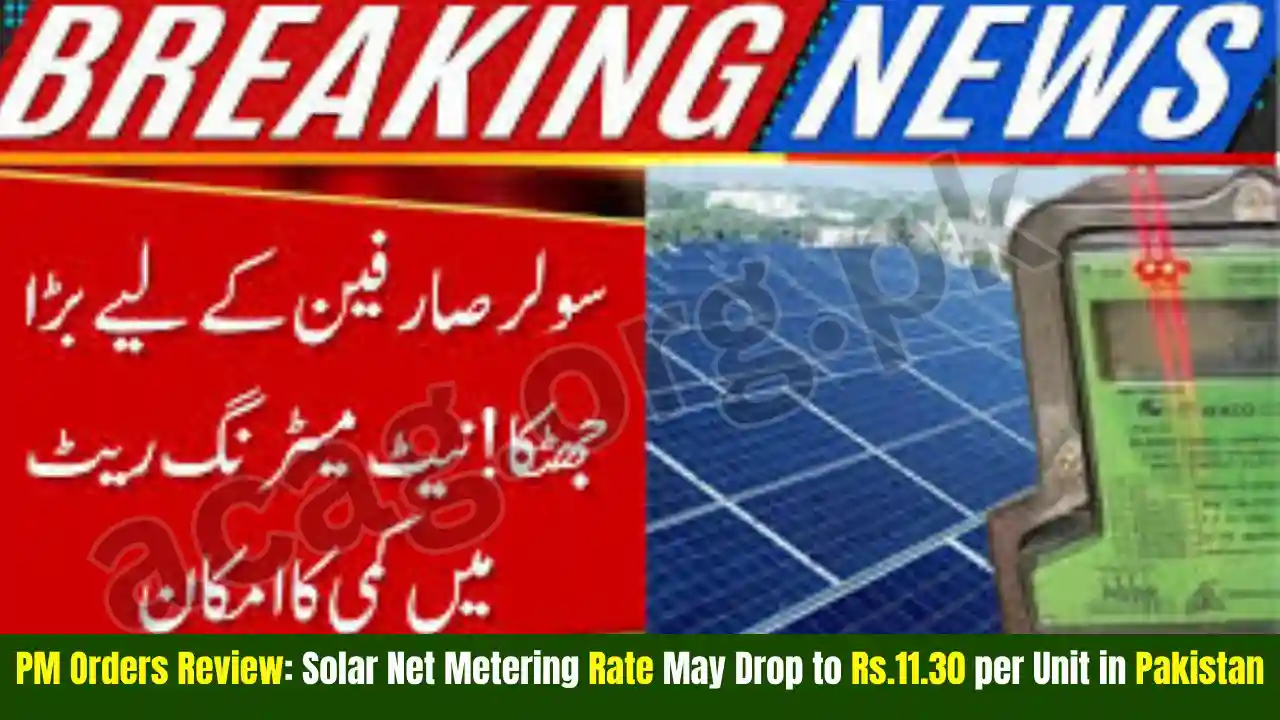
The PM Orders Review Solar Net Metering Pakistan 2025 is entering a critical phase as the government considers revising the national net-metering tariff. According to recent directives from the Prime Minister’s Office, authorities have been asked to review the current net-metering policy, with proposals indicating a potential drop in buy-back rates from Rs.21 to nearly Rs.11.30 per unit.
This development has sparked intense debate among domestic consumers, industry experts, and renewable-energy advocates. While the government argues that the reduction will protect national revenue and ensure power sector stability, solar consumers fear that the decision could weaken Pakistan’s clean-energy transition, discourage new investment, and impact households that invested in rooftop solar panels to escape skyrocketing electricity bills.
This in-depth article explains the situation, reasons behind the proposed change, effects on consumers, financial impact on solar households, expert opinions, and what could happen next.
What Is Solar Net-Metering in Pakistan?
Solar net-metering allows homeowners and businesses with rooftop solar systems to sell excess electricity back to the national grid. The DISCOs (Distribution Companies) measure surplus units and credit them to the consumer’s bill at a fixed tariff.
Right now, consumers are compensated at approximately Rs.21 per unit, making solar installation highly attractive for reducing electricity bills and earning credits during sunny months.
Key Purpose of Net-Metering in Pakistan
- Promote clean & affordable energy adoption
- Reduce burden on national grid
- Lower import dependence on furnace oil & LNG
- Support environmentally friendly growth
- Empower middle-class households and small businesses
For many urban families, net-metering has been the turning point that made solar systems financially possible, reducing grid reliance, especially during summer months.
Read Also: Latest Update: Maryam Nawaz Launches Nawaz Sharif Schools of Eminence Across Punjab
PM Orders Review: Why Solar Net-Metering Rate May Drop to Rs.11.30 per Unit
The government is currently evaluating proposals from the power sector that suggest lowering the tariff to Rs.11.30 per unit. Officials argue that the current rate places pressure on national electricity capacity payments and revenue, especially for state-owned power companies already struggling with circular debt.
Key Government Concerns
- Rising circular debt exceeding Rs.2.7 trillion
- Lower grid demand due to widespread solar adoption
- Electricity distribution losses & high capacity payments
- Financial stress on DISCOs and power producers
- IMF financial conditions and structural reforms
The administration believes solar users are benefiting more compared to grid consumers who must pay hefty fuel adjustments, quarterly adjustments, and capacity charges. Officials argue that solar users consume the grid when needed but sell at premium rates, burdening national accounts.
However, consumers counter that they invested heavily into solar due to tariff hikes, inflation, and economic pressure, and the government must not change the rules after public investment.
What Happens If Net-Metering Rate Drops to Rs.11.30?
If the buy-back rate is reduced, several financial and industry effects will unfold in Pakistan.
Impact on Solar Users
- Longer payback period for solar systems
- Reduced monthly savings
- Lower incentive to install net-metering systems
- Possible unrest from existing solar users
Impact on New Solar Installations
- Decrease in installation demand
- Business slowdown for solar companies
- Job reduction in solar sector
- Higher reliance on grid & imported fuels
Impact on National Power Sector
- Grid stability in short term
- Higher dependence on fossil fuel electricity
- Slow progress on green energy transition
Long-term, this move could conflict with global climate commitments and slow Pakistan’s transition toward renewable sources.
Check Also: Faysal Bank Mera Ghar Mera Ashiana Scheme 2025 – Get PKR 3.5 Million Riba-Free Home Financin
Financial Example: Net-Metering Comparison:
| Category | Current Rate (Rs.21/unit) | Proposed Rate (Rs.11.30/unit) |
|---|---|---|
| Units exported per month | 500 | 500 |
| Monthly net-metering gain | Rs.10,500 | Rs.5,650 |
| Annual savings | Rs.126,000 | Rs.67,800 |
| Payback period for 10kW system | 4–5 years | 8–9 years |
Solar consumers clearly stand to lose significant financial benefit if the reduction takes place.
Why the Govt Wants to Reduce Solar Net-Metering Tariff:
1. Circular Debt Crisis
Pakistan’s circular debt in the power sector is increasing rapidly due to low recovery, subsidies, and capacity payments. Solar reduces grid dependence and increases financial strain on the system.
2. IMF Pressure for Power Reforms
Government programs must follow fiscal reforms. Solar incentives affect state revenue and IMF demands strict financial discipline.
3. Over-Capacity Payment Burden
Even when consumers don’t use grid power, the government must pay power producers fixed capacity charges.
4. Grid Maintenance & Transmission Costs
Even solar consumers rely on the grid at night or cloudy days.
5. Equity Argument
Government claims it is unfair that non-solar users bear additional cost burdens while solar users avoid charges.
Why Consumers Strongly Oppose This Change:
1. Huge Investment Already Made
Solar systems cost Rs.1.2–2 million for a standard home. Slashing net-metering rates after investment is seen as betrayal.
2. Renewable Energy Is a National Need
Pakistan cannot afford imported fuel dependency.
3. People Installed Solar Due to High Bills
Electricity tariffs have crossed Rs.65–Rs.80 per unit including surcharges. Solar users saved themselves from bill shock, not burdened the economy.
4. Job Creation Risk
Solar industry provides:
- 150,000+ jobs
- Thousands of businesses
- Local manufacturing supply chain
Any slowdown damages the tech & renewable ecosystem.
Read Also: Govt to Increase Petrol Prices This Week – Fuel Rates Likely to Rise from 1 November
International Comparison: Net-Metering Rates:
| Country | Net-Metering Policy |
|---|---|
| Germany | Premium net-metering, strong subsidies |
| China | FiT subsidies for solar |
| USA | State-wise net-metering, solar tax credits |
| India | Net-metering ~Rs.6–9 per unit, subsidy system |
While India has lower buy-back rates, subsidies and cheap solar hardware make solar still attractive. Pakistan’s import-based solar industry and high interest rates mean no subsidy cushion.
Possible Government Solutions Instead of Rate Reduction:
Experts suggest alternatives such as:
- Gradual tariff decline instead of sudden cut
- Subsidy for solar export units instead of flat tariff
- Night-time tariff incentives
- Feed-in-tariff structure for excess units
- Solar storage battery incentives
- Solar export peak/off-peak differentiation
The smartest solution could be a time-of-day net metering system to balance grid demand.
Stakeholder Reactions:
Solar Industry Reaction
Strong opposition, warning of industry collapse.
Consumer Response
Fear and anger on social media, campaigns trending against tariff cut.
Energy Experts
Some agree reduction is needed but call for phased adjustment.
Government Position
Under review, no final decision yet.
Will Pakistan Really Cut the Net-Metering Rate?
The proposal is under review, not finalized. But due to IMF conditions and rising capacity payments, government pressure is real. The next 60–90 days are critical for policy decision.
Expect:
- Consultations with NEPRA
- Consumer & internal ministry dialogues
- Media debate & industry lobbying
There is a high chance of policy modification, but implementation might be gradual.
How This Policy Could Affect the Future of Solar in Pakistan:
Positive Possibility
If balanced policy is created:
- Solar remains attractive
- Grid stability improves
- Fiscal pressure reduces
Negative Possibility
If sharply reduced:
- Solar adoption slows dramatically
- Public backlash increases
- Power sector remains unstable due to fossil fuel dependency
Final Thoughts:
PM Orders Review Solar Net Metering Pakistan 2025 is the future for Pakistan. The government needs to balance financial stability with long-term clean energy goals. A sudden drop to Rs.11.30 per unit may hurt households and investments, undermining renewable adoption.
A gradual, strategic, and fair policy is essential. Protecting current consumers while revising future tariff structures can create sustainable growth for Pakistan’s solar revolution.
FAQs PM Orders Review Solar Net Metering Pakistan 2025:
Will the solar net-metering rate really drop to Rs.11.30 in Pakistan?
Not finalized yet. The PM has ordered a review, but the decision is pending.
Why is the government considering reducing the net-metering tariff?
Due to circular debt, IMF pressure, and financial sustainability concerns for power companies.
Will existing solar users be affected?
Possible, but industry is demanding protection for existing users.
What is the current net-metering rate?
Approximately Rs.21 per unit.
How will this affect solar system payback time?
It may increase from 5 years to nearly 8–9 years for many consumers.