Pakistan and Turkiye Sign Major MoUs to Boost Oil, Gas & Mining Cooperation 2025
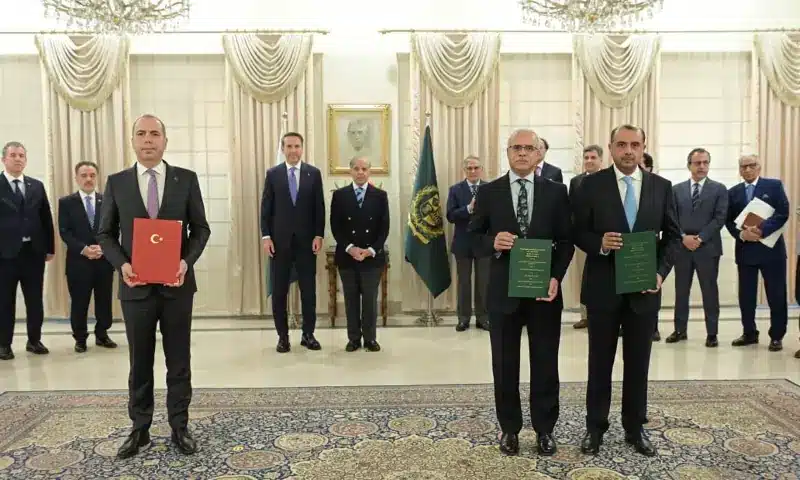
Pakistan and Turkiye have taken a major step toward strengthening their strategic partnership by signing five new Memoranda of Understanding (MoUs) and deeds of assignment focused on oil and gas exploration, mining development, and energy-sector collaboration.
The agreements were signed during the visit of a high-level Turkish delegation, marking a new chapter in long-term economic, trade, and energy cooperation between the two brotherly nations.
This 1500-word article explains all major details, background, benefits, future plans, investment opportunities, and why this development is being seen as a milestone for both Pakistan and Turkiye.
1. Overview of the New Pakistan–Turkiye Energy Agreements
On Tuesday, Pakistan and Turkiye signed five MoUs that cover both offshore and onshore petroleum fields. These agreements include:
- Eastern Offshore Indus-C Block
- Ziarat North Block
- Sukhpur-II Block
- Deep C Block
- Offshore Deep F Block
The signing ceremony was witnessed by Prime Minister Shehbaz Sharif, who called it a major achievement for Pakistan’s energy future.
These MoUs provide a framework for:
- Joint exploration of natural gas and oil
- Expansion of mining activities
- Technology-sharing
- Training and capacity-building
- Future equity participation in the power sector
- Investment in petroleum infrastructure
- Long-term cooperation between both governments
2. Turkish Petroleum Expands Its Footprint in Pakistan
One of the biggest announcements was that Turkish Petroleum (TPAO) will be joining both offshore and onshore exploration projects in Pakistan.
To strengthen its operations, the company will:
- Open a new office in Islamabad this month
- Employ both Turkish and Pakistani technical teams
- Participate in high-value petroleum exploration
- Evaluate opportunities in shale gas, tight gas, and conventional reserves
This will allow Pakistan to benefit from advanced Turkish drilling technologies and years of exploration experience.
3. Pakistan–Turkiye Trade Target: $5 Billion in 3 Years
Prime Minister Sharif highlighted the deep and historic bond between Pakistan and Turkiye. He reminded both sides of the goal, set jointly by PM Shehbaz Sharif and President Erdogan in 2022, to increase bilateral trade to $5 billion within three years.
Current trade progress:
- $1.4 billion in 2024
- Up from $1.1 billion in 2021
The PM said that increased cooperation in energy, mining, power, and infrastructure will play a central role in achieving this target.
Read Also:Pakistan Gold Rate 26 November 2025 – Updated 24K Tola, Gram & Ounce Prices
4. Key Sectors Covered Under the New MoUs
Oil and Gas Exploration
The MoUs allow Turkish companies to explore both deep-sea offshore energy blocks and large onshore oil fields in Pakistan.
Pakistan’s petroleum sector is currently exploring major areas of:
- Sindh Basin
- Balochistan
- Indus Offshore Basin
- Khyber Pakhtunkhwa (KPK)
Turkiye’s investment can help accelerate exploration and reduce reliance on imported fuel.
Mining and Mineral Development
Pakistan is rich in minerals such as:
- Copper
- Gold
- Lithium
- Chromite
- Rare earth minerals
- Coal reserves
The new MoUs enable:
- Turkish companies to conduct geological surveys
- Exploration under joint ventures
- Technology transfer for modern mining practices
- Collaboration in mineral processing
Equity Participation in the Power Sector
Turkiye is also being encouraged to invest in:
- Electricity distribution companies (DISCOs)
- Energy infrastructure
- Renewable power projects
- Power sector privatization
Pakistan’s Power Minister Awais Leghari invited Turkish companies to take part in the privatization of the first three DISCOs, for which expressions of interest will be announced soon.
5. Why These Agreements Are Important for Pakistan
1. Reducing Dependence on Imported Fuel
Pakistan spends billions annually on imported LNG and petroleum.
Joint exploration could reduce import bills.
2. Strengthening Foreign Investment
Turkiye is a trusted partner and long-term investor.
These MoUs provide stability and investor confidence.
3. Advanced Exploration Technology
Turkiye has modern offshore drilling expertise, which Pakistan needs for deep-sea exploration.
4. Job Creation
New projects will create jobs for:
- Geologists
- Engineers
- Technicians
- Support staff
5. Boosting Local Energy Production
Increased domestic production means:
- Lower energy prices
- Fewer power shortages
- Improved industrial output
6. Statements from Pakistani and Turkish Leadership
Prime Minister Shehbaz Sharif
He praised the agreements as a major step toward achieving the $5 billion trade goal, and highlighted:
- Trust between both nations
- Long-term friendship
- Strong energy and business cooperation
Turkish Energy Minister Alparslan Bayraktar
He said Turkiye aims to:
- Expand ventures in Pakistan
- Strengthen oil and gas ties
- Support mining and energy infrastructure
- Increase bilateral trade
He emphasized that energy collaboration will play a major role in achieving trade targets.
7. Pakistan Ready for Large-Scale Turkish Investments
During meetings with:
- COAS Field Marshal Asim Munir
- Petroleum Minister Ali Pervaiz Malik
- Power Minister Awais Leghari
The Turkish delegation expressed readiness to launch long-term energy partnerships.
8. Mari Energies, OGDCL & PPL Present Investment Opportunities
Senior energy companies in Pakistan briefed the Turkish delegation about:
- New petroleum discoveries
- Future drilling plans
- Shale and tight gas potential
- Mineral and mining investments
- Joint venture possibilities
Companies involved:
- Mari Petroleum / Mari Energies
- Oil and Gas Development Company Ltd (OGDCL)
- Pakistan Petroleum Limited (PPL)
This collective approach aims to open Pakistan’s natural-resource sector to high-quality foreign investment.
9. Joint Trading Company for Petroleum Procurement
Both countries agreed to explore the idea of setting up a joint petroleum trading company.
Possible functions:
- Bulk petroleum imports
- Joint LNG procurement
- Infrastructure projects
- Petroleum storage facilities
- Securing better global pricing
This would reduce Pakistan’s dependence on expensive spot markets.
Read Also:Gold Rates in Pakistan Today – 26 November 2025 (Per Tola & Per Gram Latest Update)
10. Upcoming Ministerial Visit to Turkiye
Pakistan will soon send a ministerial-level delegation to Turkiye to discuss:
- Deeper energy cooperation
- Mining and mineral development
- Refinery projects
- Renewable energy solutions
- Technology-sharing
This visit is expected to finalize new agreements for 2026–2030.
11. Economic Impact on Both Countries
For Pakistan:
- Reduced energy imports
- Increased gas exploration
- Stronger foreign investment
- More jobs
- Lower energy costs
For Turkiye:
- Entry into a fast-growing market
- Access to new offshore resources
- Regional expansion of Turkish Petroleum
- Stronger diplomatic ties
12. Conclusion: A New Era of Pakistan–Turkiye Strategic Energy Partnership
The signing of these MoUs marks a historic moment in Pakistan–Turkiye relations.
From oil and gas to mining and electricity distribution, both nations are moving toward long-term, stable, and mutually beneficial cooperation.
With new offshore exploration, increased Turkish investment, better technology, and strategic collaboration, Pakistan’s energy sector could see a major breakthrough in the coming years.
This partnership is expected to play a central role in achieving the $5 billion bilateral trade target and transforming energy cooperation into a long-term economic engine for both countries.
Pakistan–Turkiye Energy MoUs FAQs 2025
1. What MoUs were signed between Pakistan and Turkiye?
Five MoUs and deeds of assignment for offshore and onshore petroleum blocks, mining cooperation, and energy-sector collaboration.
2. Which petroleum fields are included in the agreements?
Indus-C Offshore, Ziarat North, Sukhpur-II, Deep C Block, and Offshore Deep F Block.
3. What role will Turkish Petroleum play?
TPAO will explore offshore and onshore fields, open an office in Islamabad, and partner with Pakistani companies.
4. How will these agreements benefit Pakistan?
They will boost investment, increase local gas production, reduce energy imports, and create jobs.
5. What is the trade target set by Pakistan and Turkiye?
Both nations aim to increase bilateral trade to $5 billion within three years.