
Introduction
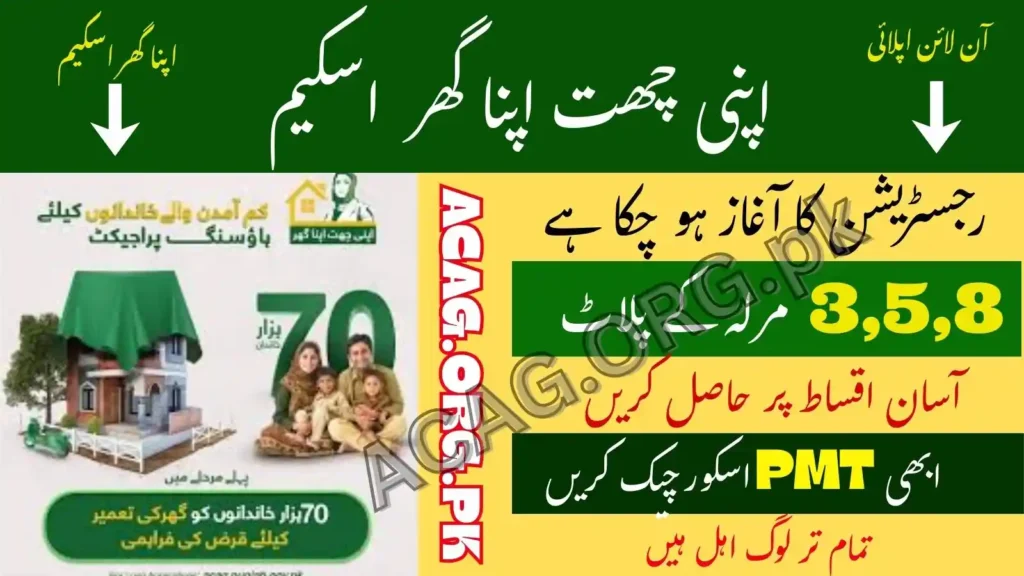
The Apni Chhat Apna Ghar (ACAG) Program 2025 is one of the largest housing schemes launched by the Government of Punjab. With the aim of delivering 100,000 affordable houses and apartments, this initiative is focused on low-income families who are struggling with high rents or living in informal settlements.
This program not only helps families achieve the dream of owning a home but also contributes to economic growth, job creation, and social upliftment across Punjab. Through digital systems and transparent processes, ACAG ensures that deserving families get a fair opportunity without the involvement of middlemen.
Background of ACAG Program
For decades, low-income and middle-class families in Punjab faced the challenge of unaffordable housing. Many had to spend most of their income on rent, while others lived in overcrowded areas without access to basic facilities. This created long-term social and financial struggles.
- Housing has been a major problem for low & middle-income families in Punjab.
- Families spend most income on rent or live in overcrowded areas.
- The Punjab government launched ACAG to solve this long-standing issue.
- Program executed by PHATA and supervised by HUD&PHED.
- Supports both urban & rural families with structured housing.
To solve this issue, the Punjab government introduced the ACAG program, executed by the Punjab Housing & Town Planning Agency (PHATA) and administered by the Housing, Urban Development & Public Health Engineering Department (HUD&PHED). It is designed to support both rural and urban families through structured housing solutions.
Key Features of ACAG Program
The program has been structured to ensure maximum benefits for deserving households. It promises to build 100,000 houses within 4.5 years, with construction spread across different regions of Punjab.
- 100,000 houses planned in 4.5 years.
- Includes urban, rural, and PPP models.
- Entire process is digital & transparent.
- Focused on low-income & deserving families.
- Provides security, stability, and empowerment.
It introduces three execution models—urban housing, rural housing, and public-private partnerships. All processes, from application to verification, are online and transparent. Families will not only get affordable homes but also long-term benefits like security, stability, and economic empowerment.
Expected Outcomes of ACAG Program
The ACAG program goes beyond housing—it is a step toward improving quality of life in Punjab. Families moving into these houses will experience healthier environments with proper sanitation, clean water, and electricity.
- Better living conditions with clean water & electricity.
- Reduction in slums & overcrowding.
- Safer and healthier communities.
- Over 500,000 direct & indirect jobs created.
- Boost for industries like cement, steel, construction.
Additionally, the project will help reduce slums, provide safer communities, and improve social harmony. On the economic side, construction of 100,000 homes will generate over 500,000 direct and indirect jobs, supporting industries like cement, steel, and small businesses.
Eligibility Criteria Of ACAG Program
Applicants must fulfill certain conditions to be eligible. First, the applicant must be the head of the family as per NADRA records and a permanent resident of Punjab with a valid CNIC. They should own 5 Marla or less land in urban areas or 10 Marla or less in rural areas.
- Applicant must be head of family (as per NADRA).
- Must be a permanent resident of Punjab (CNIC-based).
- Can own ≤ 5 Marla land in urban or ≤ 10 Marla in rural areas.
- No criminal record or loan defaults allowed.
- Must be registered in NSER database with PMT ≤ 60.
Moreover, applicants must not have a criminal record or be loan defaulters. Importantly, they must be registered with the NSER database and have a PMT score of 60 or below, ensuring that only low-income families benefit from the program.
Who Will Benefit the Most?
The scheme directly targets low-income families who are living in rented houses, informal settlements, or unsafe environments. Families with small land parcels but no financial resources to build a house are also eligible.
- Families living in rented houses.
- Residents of informal/slum settlements.
- Small landowners lacking resources to build.
- Widows & women household heads.
- Families in rural Punjab without housing schemes.
It also benefits widows, women household heads, and rural families who often lack access to modern housing schemes. By focusing on such groups, ACAG Punjab ensures inclusivity and fairness in housing development.
Execution Models of ACAG
To cater to different segments of society, the scheme follows three models. The Urban Housing Model focuses on building apartments and small houses in city areas for families with limited land.
- Urban Model: Apartments & small houses for city dwellers.
- Rural Model: Support to build homes on small rural lands.
- Public-Private Partnership Model: Developers + government for large-scale projects.
The Rural Housing Model supports families in villages by providing resources to build houses on small land parcels. The third model, Public-Private Partnership, engages private developers for mass construction, ensuring large-scale and faster delivery.
Economic & Social Impact
The program is designed to leave a lasting social and economic footprint. On the economic side, it boosts the construction industry, generates employment, and increases business for related sectors like materials and transport.
- Boost for construction industry & allied sectors.
- Creation of employment opportunities.
- Improved social stability & equality.
- Families get ownership, security & dignity.
- Long-term impact on health, education, & quality of life.
Socially, it gives families a sense of security, ownership, and stability. Better housing leads to improved health, education, and safety, while also reducing inequality and promoting stronger communities across Punjab.
ACAG Login, Apply, Complaint Portal & Status

















acag.punjab.gov.pk login
The acag.punjab.gov.pk login page is the official entry point for applicants who have already registered in the Apni Chhat Apna Ghar program. By logging in, families can check their submitted application, track verification results, and view official updates from the government.
To log in, users must enter their CNIC number and password. The portal is secure and user-friendly, ensuring that personal data remains protected. Through this dashboard, families can also download acknowledgment slips and track notifications about balloting and deadlines.

acag.punjab.gov.pk online apply
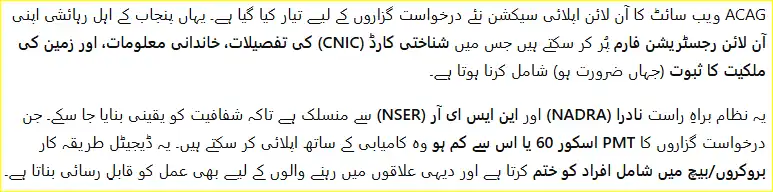
The online apply section of the ACAG website is designed for new applicants. Here, eligible residents of Punjab can fill out the online registration form by entering CNIC details, family information, and proof of land ownership where required.
The system is directly linked with NADRA and NSER to ensure transparency. Applicants with a PMT score of 60 or below can apply successfully. This digital approach eliminates middlemen and makes the process accessible even to those living in rural areas.
ACAG login
The ACAG Mobile login option is a convenient tool for families who want to re-enter their profiles after initial registration. It allows them to monitor progress, verify details, and make corrections if required.
Regularly checking the login portal ensures applicants never miss important updates like registration deadlines, eligibility changes, or housing allotment results. It is highly recommended that families log in at least once a week to stay informed.

ACAG complaint portal
The ACAG complaint portal is an innovation introduced to support applicants facing technical issues, disputes, or delays. Through this portal, any registered applicant can file a complaint online without visiting physical offices.
Every complaint is tracked through a unique ID, and applicants can check its progress directly on the portal. This system builds trust by making the program more transparent and by giving low-income families a platform to raise their voices.

ACAG list
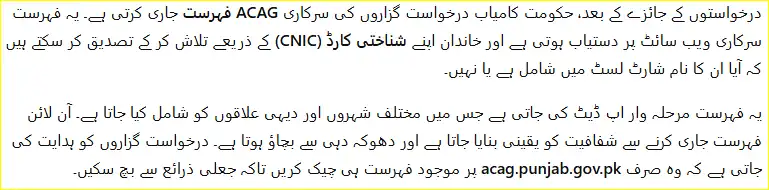
Once applications are reviewed, the government publishes the official ACAG list of successful applicants. This list is available on the official website and allows families to search by their CNIC to confirm whether they have been shortlisted.
The list is updated in phases, covering different cities and rural areas. Publishing this list online ensures transparency and prevents fraud. Applicants are advised to only check the list on acag.punjab.gov.pk to avoid fake sources.
acag.punjab.gov.pk application status
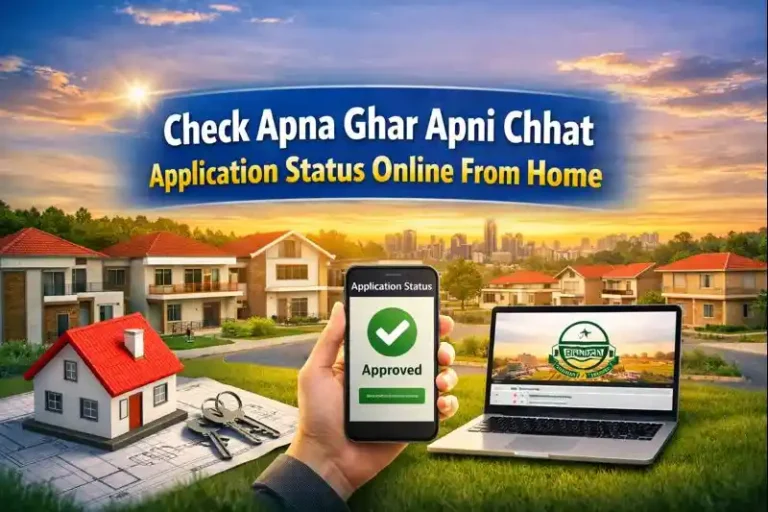
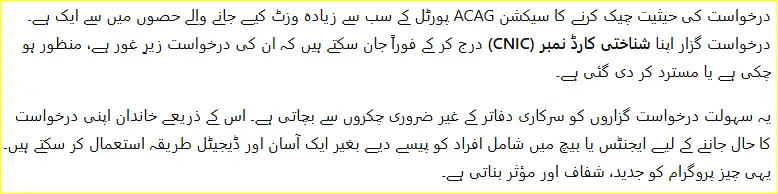
The application status check is one of the most frequently visited sections of the ACAG portal. Applicants can enter their CNIC number and instantly know whether their application is under review, approved, or rejected.
This feature saves applicants from unnecessary visits to government offices. It creates an easy, digital way for families to follow their case without paying agents or middlemen. This makes the program modern, transparent, and efficient.
acag.punjab.gov.pk application status
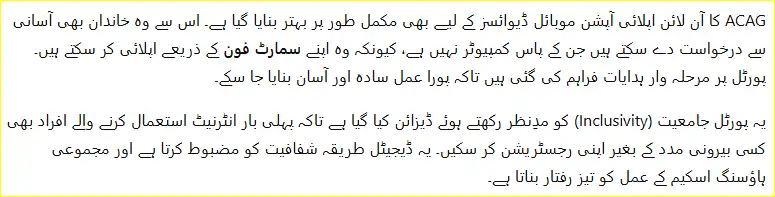
The ACAG online apply option is also optimized for mobile devices. This ensures that even families without computers can easily apply using their smartphones. Step-by-step instructions are provided to make the process simple.
The portal is designed with inclusivity in mind, so that even first-time internet users can register themselves without external help. This digital approach strengthens transparency and speeds up the overall housing scheme.
acag.punjab.gov.pk list
The official beneficiary list of ACAG is always hosted on the domain acag.punjab.gov.pk. Families must only rely on this official list because it is government-backed and completely accurate.
This list includes names of successful applicants categorized by region and city. Publishing it online ensures that every applicant has equal access to results, making the process more fair and transparent.

Apni Chhat Apna Ghar Program Online Registration
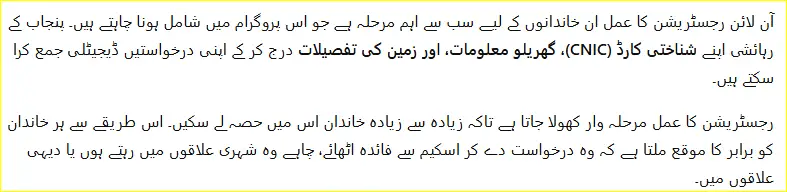
The online registration process is the most important step for families who want to join the program. By entering CNIC, household information, and land details, residents of Punjab can submit their applications digitally.
The registration process is opened in phases to allow maximum participation. This gives every family an equal opportunity to apply and benefit from the scheme, regardless of whether they live in urban or rural areas.
Apni Chat Apna Ghar PMT Score
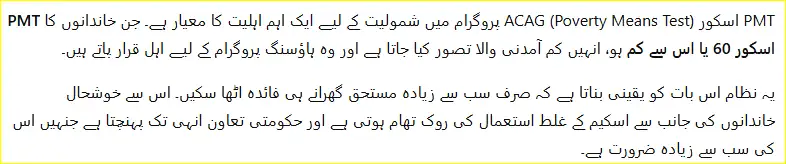
The PMT score (Poverty Means Test) is a key eligibility factor for ACAG. Families with a PMT score of 60 or below are considered low-income and qualify for the housing program.
This system ensures that only the most deserving households benefit. It prevents misuse by wealthier families and directs government support to those who need it most.
Apna Ghar Scheme Online Registration Last Date
Every registration round has an official ACAG last date announced by the Punjab government. Families must apply before this deadline; otherwise, they may need to wait for the next phase.
It is strongly recommended that applicants submit their forms as early as possible. This reduces the risk of missing out due to last-minute internet issues or technical delays.

Apna Ghar Scheme Online Registration Form
The ACAG registration form is available on the official ACAG portal. Applicants must provide personal details, CNIC, land ownership proof, and family information to complete the form.
After submission, the form is automatically verified through NADRA and NSER systems. This process ensures that only genuine and deserving families are considered for allotment.

Apna Ghar Scheme Online Registration 2025
The 2025 registration cycle introduces new features like online complaint resolution, digital tracking, and faster verification systems. These updates improve accessibility and reduce waiting times.
In this phase, priority is being given to families who are living in rented houses and struggling with rising costs. This reflects the government’s commitment to addressing urgent housing challenges.

Apni Chat Apna Ghar Login
The Apni Chat Apna Ghar login allows applicants to revisit their profiles after registration. From here, they can check status updates, download slips, and ensure their application is still valid.
By logging in frequently, applicants stay updated on allotment schedules and avoid missing important announcements. The login system is the backbone of applicant communication with the program.
Apni Chat Apna Ghar Registration
The registration process requires applicants to be verified residents of Punjab with valid NADRA records. Only the family head can apply to ensure fairness across households.
This digital registration eliminates paperwork, reduces delays, and makes the scheme more accessible to rural families who previously struggled to access such opportunities.
Apna Ghar Apni Chat Application Status Check
The application status check tool allows families to instantly verify whether their application is pending, approved, or rejected. This is a quick, reliable way of staying updated without visiting offices.
By entering their CNIC number, applicants can track their cases anytime. This reduces stress, improves transparency, and ensures equal access for all families across Punjab.
Application Process, Documents, FAQs & Conclusion
Application Process for ACAG Program 2025
The application process for the Apni Chhat Apna Ghar (ACAG) program is simple and fully digital. Applicants need to visit the official portal at acag.punjab.gov.pk, where they can access the citizen registration form. The form requires basic details like CNIC, household information, and land ownership details.
Once the form is filled out, the system automatically verifies the data through NADRA and NSER databases. This ensures that only genuine and eligible families are considered. If the application is successful, applicants receive a confirmation SMS or email about the next steps in the process.
Application Process for ACAG Program 2025
Step 1: Visit the Official Website
Applicants must start by visiting the official ACAG Punjab portal. The website contains all the relevant information, guidelines, and the link to the registration form.
It is important to only use the official domain (acag.punjab.gov.pk) for registration. This prevents fraud and ensures that the data entered is directly recorded in the government’s housing database.
Step 2: Fill Citizen Registration Form
The registration form is straightforward and designed to be user-friendly. Applicants are required to enter their CNIC number, family information, and details of land ownership (if applicable).
This form ensures that the government can cross-check the applicant’s socio-economic status through official records. It also helps to identify genuine low-income families who truly deserve the program’s support.
Step 3: Verification
Once the application is submitted, the verification process begins. Data is verified through NADRA records to confirm identity and through NSER databases to check the Poverty Means Test (PMT) score.
If the applicant meets the eligibility requirements, their status is updated to “Approved.” If additional clarification is needed, the status may remain “Under Review” until verification is complete.
Step 4: Confirmation
After successful verification, applicants receive a confirmation SMS or email. This notification includes details about the next steps, such as balloting schedules or allotment procedures.
Confirmation ensures that families are officially part of the scheme and can expect further updates directly from the government portal without relying on agents or middlemen.
ACAG Ghar Scheme Required Documents 2025
Applicants must prepare certain documents before applying to avoid delays. These documents include:
- CNIC copy of the applicant (and spouse, if applicable).
- Proof of residency, such as utility bills or domicile.
- Proof of land ownership, if the applicant owns land within the allowed limit.
- NSER registration details to confirm PMT score eligibility.
These documents help the government maintain a transparent and fair selection process. Preparing them in advance also makes the application process smoother and quicker.
Importance of Document Verification
Document verification is a critical step in the ACAG program. It ensures that the support reaches genuine low-income families and prevents fraud or multiple applications from the same household.
The government uses digital cross-verification with official databases, making the process both efficient and transparent. Applicants must provide accurate information to avoid rejection.
Frequently Asked Questions (FAQs) About Apni Chhat Apna Ghar Program October 2025
Q1: What is ACAG?
The Apni Chhat Apna Ghar (ACAG) program is a housing scheme launched by the Punjab Government to provide 100,000 affordable houses and apartments to low-income families.
Q2: Who can apply?
Any permanent resident of Punjab who meets the eligibility criteria (PMT score ≤ 60, no criminal record, and small land ownership limits) can apply.
Q3: Is the program open to both rural and urban families?
Yes, the scheme covers both urban and rural applicants, with separate models designed for their needs.
Q4: Is there a fee for applying?
The government may charge a small processing fee, if applicable. However, the registration process is primarily free and transparent.
Q5: How will houses be allotted?
Allotments are made through a computerized balloting system, ensuring fairness and transparency.
Q6: Can women apply for ACAG?
Yes, women who are household heads, widows, or landowners are fully eligible to apply. This ensures inclusivity in the program.
Q7: How can I check my application status?
Applicants can check their status by logging into acag.punjab.gov.pk with their CNIC number. The portal shows whether the application is approved, under review, or rejected.
ACAG Scheme Conclusion:
The Apni Chhat Apna Ghar (ACAG) Program 2025 is more than just a housing initiative—it is a lifeline for low-income families across Punjab. By providing 100,000 affordable houses, it promises not only shelter but also dignity, stability, and economic empowerment.
The program’s strength lies in its transparent digital process, fair eligibility checks, and government-backed support. Families are encouraged to apply online, prepare documents in advance, and stay updated through the official portal.
For anyone living in Punjab without secure housing, this is a golden opportunity to own a home under the government’s support. Applicants should not delay and must apply before the last date to secure their chance at a brighter, more stable future.
👉 Apply Online Now at acag.punjab.gov.pk